In traditional blockchain systems, users usually think in terms of “wallets” and “smart contracts.” On Solana, however, almost everything revolves around accounts . Programs, tokens, NFTs, user balances, and even executable code are all stored inside different account types.
Understanding Solana account architecture is essential for developers building on the network. Compared with Ethereum’s contract storage model, Solana’s account system is more explicit, modular, and optimized for high-performance parallel execution.
This article explains the major Solana account types, how they work internally, and why they are critical to Solana’s scalability.
A Solana account is essentially a container that stores:
- SOL balances
- Program state data
- Executable code
- Token ownership information
- Metadata
Every piece of on-chain data exists inside an account.
Unlike Ethereum, where smart contracts directly hold internal storage, Solana separates data storage from executable programs. This separation is one of the reasons Solana can process transactions in parallel.
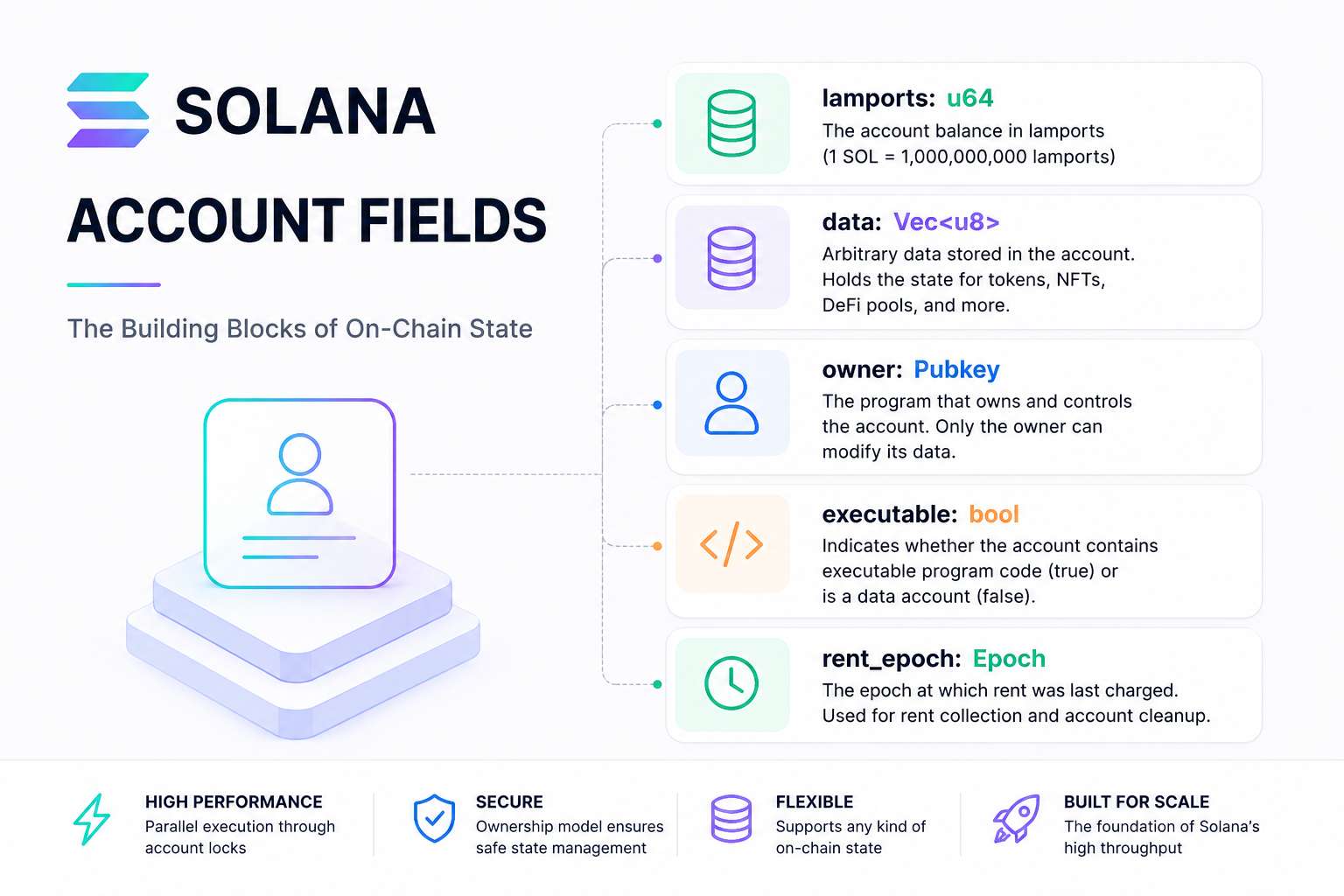
Each account contains:
FieldDescriptionLamportsSOL balanceOwnerProgram that controls the accountDataArbitrary binary dataExecutableWhether the account contains executable codeRent EpochRent collection tracking
Why Solana Uses AccountsSolana’s runtime is optimized for speed and concurrency.
Before a transaction executes, Solana requires the transaction to explicitly declare which accounts it will read or modify. This allows the runtime to determine whether transactions can run in parallel without conflicts.
Benefits include:
- Massive parallel execution
- Predictable state access
- Reduced runtime ambiguity
- Higher throughput
- Better scalability
This design is fundamentally different from Ethereum’s global shared state model.
There are several important account categories developers should understand.
System accounts are the most basic account type on Solana.
They are typically wallet accounts controlled by a keypair and owned by the System Program.
System accounts can:
- Hold SOL
- Send transactions
- Pay fees
- Create new accounts
A newly generated wallet address is usually a system account.
Example:
const accountInfo = await connection.getAccountInfo(publicKey);
If the owner is the System Program, it is likely a standard wallet account.
Program accounts contain executable smart contract code.
These accounts are marked as:
executable = true
Unlike Ethereum contracts, Solana programs are usually stateless. They do not directly store user data internally. Instead, they operate on separate data accounts passed into instructions.
Characteristics:
PropertyValueStores executable codeYesStores mutable stateUsually noUpgradeableOptionalExecutabletrue
Programs are deployed as accounts on-chain.
Common examples include:
- Token Program
- Associated Token Program
- Metaplex Programs
- Jupiter Programs
Data accounts store program state.
Programs read and modify these accounts during execution.
Examples:
- AMM liquidity pool state
- NFT metadata
- User staking information
- Order books
- DAO governance state
A data account is typically owned by a program:
owner = ProgramID
The owning program has permission to modify the account data.
This architecture creates a clean separation between:
- Logic → Program accounts
- State → Data accounts
Token accounts are specialized accounts used by the SPL Token Program.
Unlike Ethereum ERC-20 balances, token balances are not stored directly inside wallets. Instead, each token balance exists in a separate token account.
A token account stores:
FieldDescriptionMintWhich token it belongs toOwnerWallet ownerAmountToken balance
For example:
- USDC balance
- BONK balance
- Wrapped SOL balance
All exist in independent token accounts.
An Associated Token Account is a standardized token account derived from:
Wallet Address + Token Mint
This ensures users have a predictable token account address for every SPL token.
Benefits:
- Easier wallet integrations
- Standardized token handling
- Simplified UX
Most wallets automatically create ATAs when receiving tokens.
Mint accounts define a token itself.
They store token-level configuration such as:
FieldDescriptionSupplyTotal supplyDecimalsPrecisionMint AuthorityWho can mintFreeze AuthorityWho can freeze
For example, the USDC mint account defines:
- Total USDC supply on Solana
- Decimal precision
- Mint permissions
All token accounts referencing that mint share the same token definition.
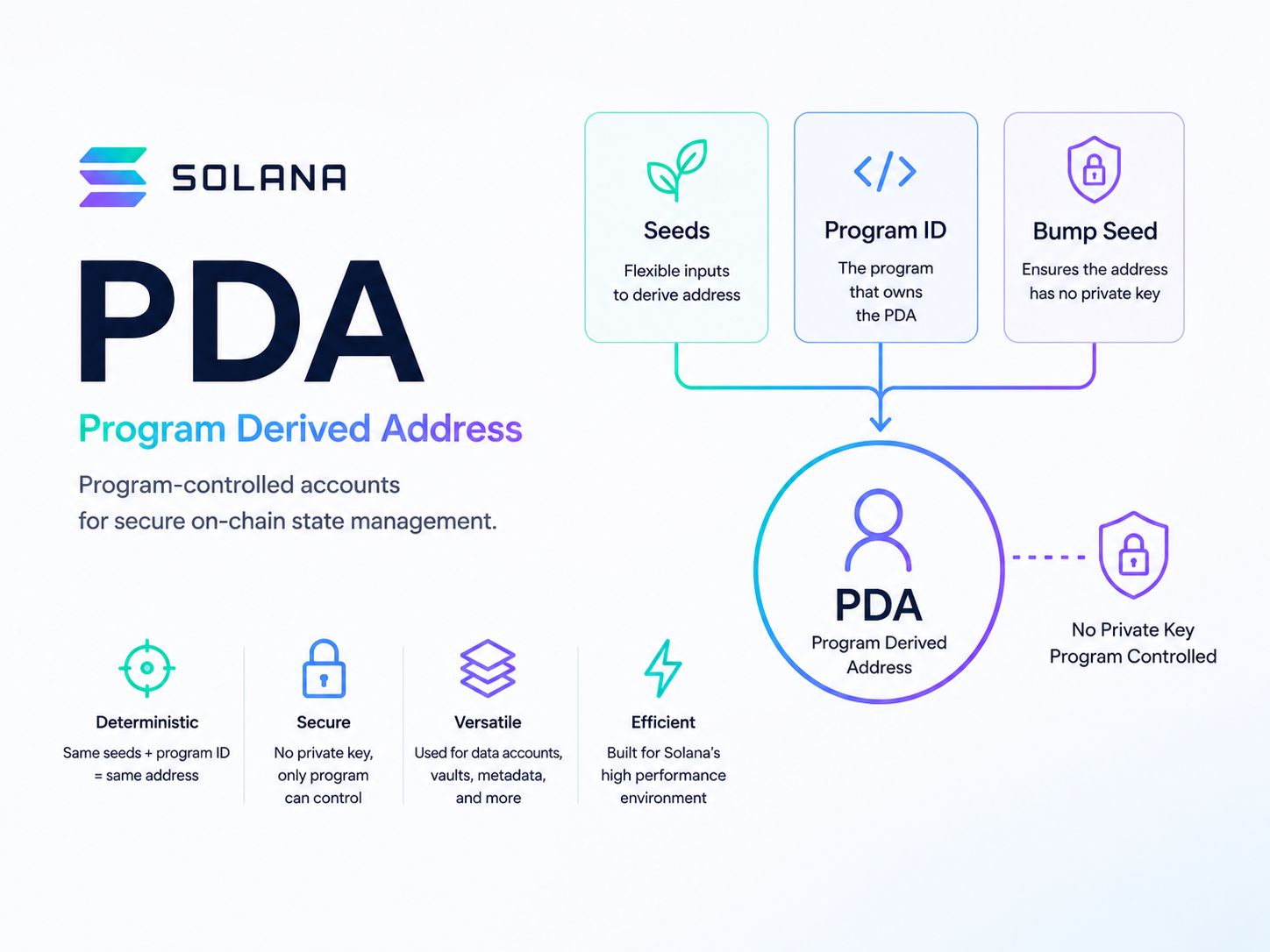
PDAs are deterministic accounts generated by programs.
They do not have private keys.
Instead, they are controlled entirely by program logic.
PDAs are extremely important in Solana development because they allow programs to securely manage state.
Example use cases:
- User vaults
- Escrow accounts
- Liquidity pools
- NFT metadata
- Staking records
PDAs are generated using:
PublicKey.findProgramAddressSync()
Advantages:
- Deterministic addresses
- No private key management
- Secure program ownership
- Predictable state structure
Sysvar accounts store network-level runtime information.
These are built-in read-only accounts provided by the Solana runtime.
Examples include:
SysvarPurposeClockCurrent timestamp and slotRentRent parametersEpochScheduleEpoch informationRecentBlockhashesRecent block hashes
Programs use sysvars to access blockchain context.
Example:
- Checking current slot
- Calculating staking rewards
- Time-lock validation
On Solana, storing data consumes blockchain resources.
Accounts must maintain a minimum SOL balance called:
Rent-exempt balance
If the balance is too low, the account may eventually be deleted.
Larger accounts require more SOL to remain rent exempt.
Example:
Account TypeTypical SizeWallet accountSmallToken account~165 bytesNFT metadataLargerAMM pool stateMuch larger
Rent encourages efficient storage usage across the network.
Solana distinguishes accounts using the executable flag.
TypeExecutableWallet AccountNoToken AccountNoPDANoProgram AccountYes
Only executable accounts can process instructions.
Every account has an owner.
The owner determines which program can modify the account’s data.
Example:
AccountOwnerWallet AccountSystem ProgramToken AccountSPL Token ProgramNFT MetadataMetaplex Program
Programs cannot arbitrarily modify accounts they do not own.
This creates strong security boundaries.
The architectural differences are significant.
FeatureSolanaEthereumState StorageSeparate accountsInternal contract storageParallel ExecutionYesLimitedExplicit Account AccessRequiredNot requiredToken BalancesSeparate token accountsStored in contractsStateless ProgramsCommonRare
Solana’s model is more complex initially, but enables far higher throughput.
A simple USDC transfer may involve:
- Sender wallet account
- Sender USDC token account
- Receiver wallet account
- Receiver USDC token account
- USDC mint account
- SPL Token Program
This explicit structure allows Solana to process transactions efficiently and safely.
The account architecture is one of the most important innovations in Solana.
It enables:
- Parallel transaction execution
- High TPS
- Predictable runtime behavior
- Modular program design
- Efficient state management
For developers, understanding accounts is foundational to:
- Writing programs
- Debugging transactions
- Managing state
- Optimizing performance
- Building scalable dApps