What is ERC721?
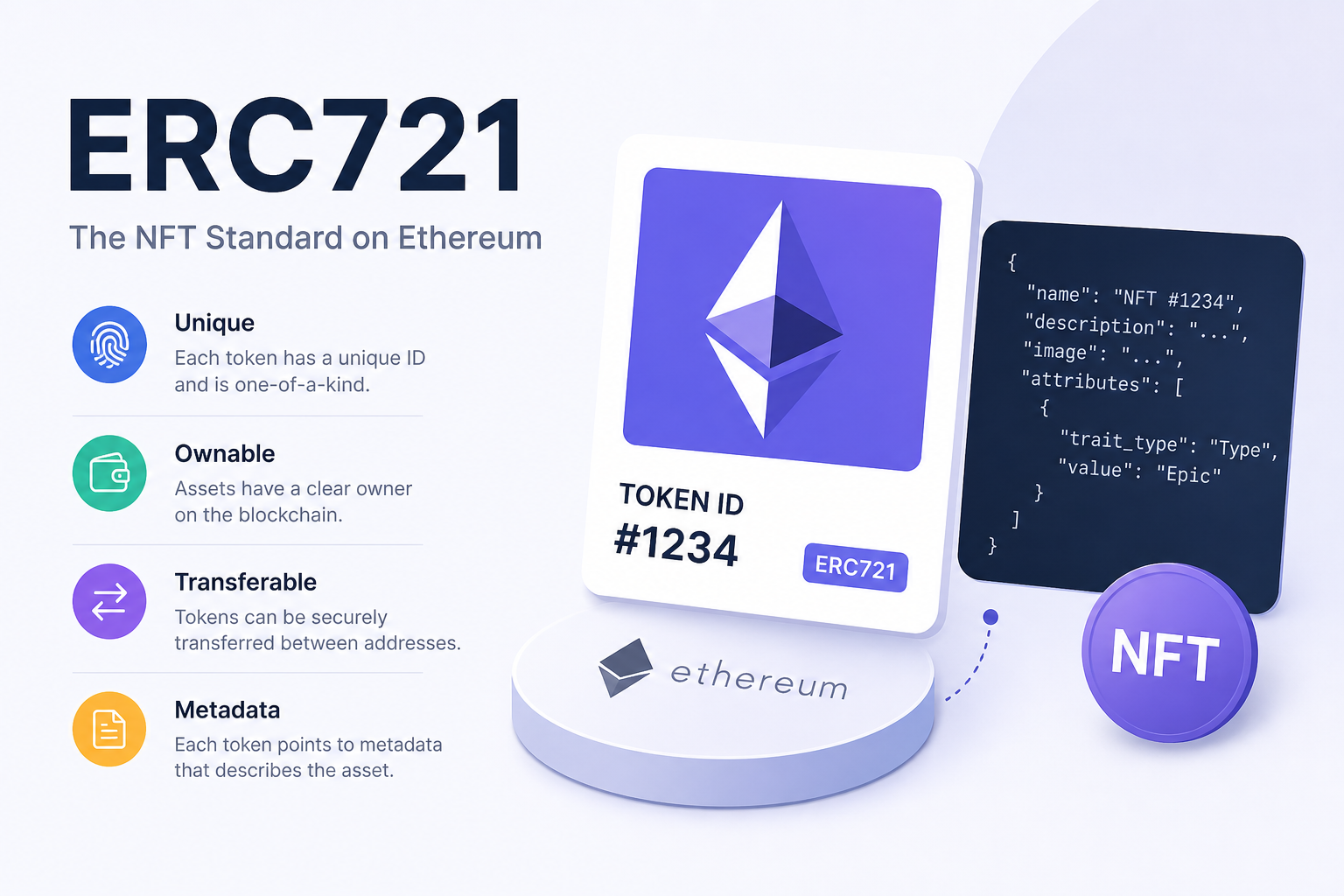
ERC-721 is a smart contract standard running on the Ethereum blockchain for creating non-fungible tokens (NFTs).
Before ERC721, most blockchain assets were fungible assets such as ETH or USDT, where every token unit was identical and interchangeable.
However, many real-world assets are naturally unique, including:
- Artwork
- Concert tickets
- Gaming items
- Virtual land
- Collectibles
ERC721 introduced the ability to represent unique digital ownership directly on-chain.
The Origin of ERC721
In 2017, blockchain gaming started gaining traction. One of the earliest and most influential projects was:
CryptoKitties
The game allowed users to own and trade unique virtual cats, each with different attributes and genetic combinations.
Developers quickly realized that the ERC20 standard could not properly represent unique assets.
As a result, ERC721 was proposed and later became the standard foundation for NFTs.
The Core Concept of ERC721
The design philosophy of ERC721 is straightforward:
Every token must have a unique Token ID.
For example:
tokenId #1
tokenId #2
tokenId #3
Each ID represents an individual asset.
This means:
NFT #1 is not equal to NFT #2
Even if they belong to the same collection, they remain unique.
ERC721 vs ERC20
ERC20 functions like a traditional currency system.
For example:
100 USDT
Every USDT token is identical.
Transfers only change balances.
ERC721, however, functions more like a property ownership system.
For example:
BAYC #8888
This NFT is unique.
When transferred, ownership changes rather than token quantity.
This makes ERC721 suitable for:
- NFT artwork
- Gaming items
- Virtual real estate
- Digital collectibles
- Membership systems
Core ERC721 Interfaces
ERC721 defines several key interfaces.
ownerOf()
Returns the owner of a specific NFT.
ownerOf(tokenId)
balanceOf()
Returns how many NFTs an address owns.
balanceOf(address)
transferFrom()
Transfers NFT ownership.
transferFrom(from, to, tokenId)
approve()
Allows another address to manage an NFT.
This is one of the core mechanisms enabling NFT marketplaces.
tokenURI()
Returns NFT metadata.
tokenURI(tokenId)
Typically, it points to a JSON file containing:
- NFT name
- Image URL
- Attributes
How ERC721 Works
ERC721 is fundamentally an ownership mapping system.
For example:
1 -> Alice
2 -> Bob
3 -> Charlie
Each tokenId maps to an owner address.
When an NFT is transferred, the smart contract updates the ownership mapping.
Wallets such as:
- MetaMask
- Trust Wallet
read the metadata through:
tokenURI()
and display the NFT image and properties.
Why ERC721 Matters
The importance of ERC721 goes far beyond NFT images.
Its real innovation is enabling publicly verifiable digital ownership on the blockchain.
This allows:
- True ownership of digital assets
- Permissionless transfers
- Decentralized trading
- Tamper-resistant ownership records
ERC721 became the infrastructure layer of the NFT economy.
Popular ERC721 Projects
ERC721 is widely used in:
- Digital art
- Blockchain gaming
- Metaverse land
- Membership systems
- Digital identity
Some of the most iconic projects include:
- CryptoPunks
- Bored Ape Yacht Club
NFT marketplaces such as:
OpenSea
helped accelerate the global NFT trading ecosystem.
Limitations of ERC721
Despite its importance, ERC721 has several limitations.
The first is high gas costs.
Since every NFT is individually stored, minting large collections can become expensive.
The second issue is inefficiency for batch assets.
For example:
10,000 identical tickets
Using ERC721 for such assets can be inefficient.
The Rise of ERC1155
To address these limitations, developers later introduced:
ERC-1155
ERC1155 supports:
- Fungible assets
- Non-fungible assets
- Batch transfers
This makes it more efficient for blockchain gaming ecosystems.
The Future of ERC721
Many people associate NFTs purely with profile pictures, but ERC721 represents something much larger.
In the long term, ERC721 may become the foundation of digital property rights.
Potential applications include:
- Digital identity
- AI agent identity
- On-chain certifications
- Gaming assets
- Real-world asset tokenization (RWA)
ERC721 is ultimately building the ownership layer of Web3.