The Fundamental Role of Accounts in Ethereum
Ethereum adopts an account-based state model, which differs significantly from the UTXO model used by Bitcoin. In this model, all state transitions revolve around accounts, including asset ownership, transaction initiation, and smart contract execution. Accounts serve not only as containers of value but also as fundamental units of state storage and computation. Understanding the types and structures of Ethereum accounts is essential for comprehending its operational framework.
Account Types: Externally Owned Accounts and Contract Accounts
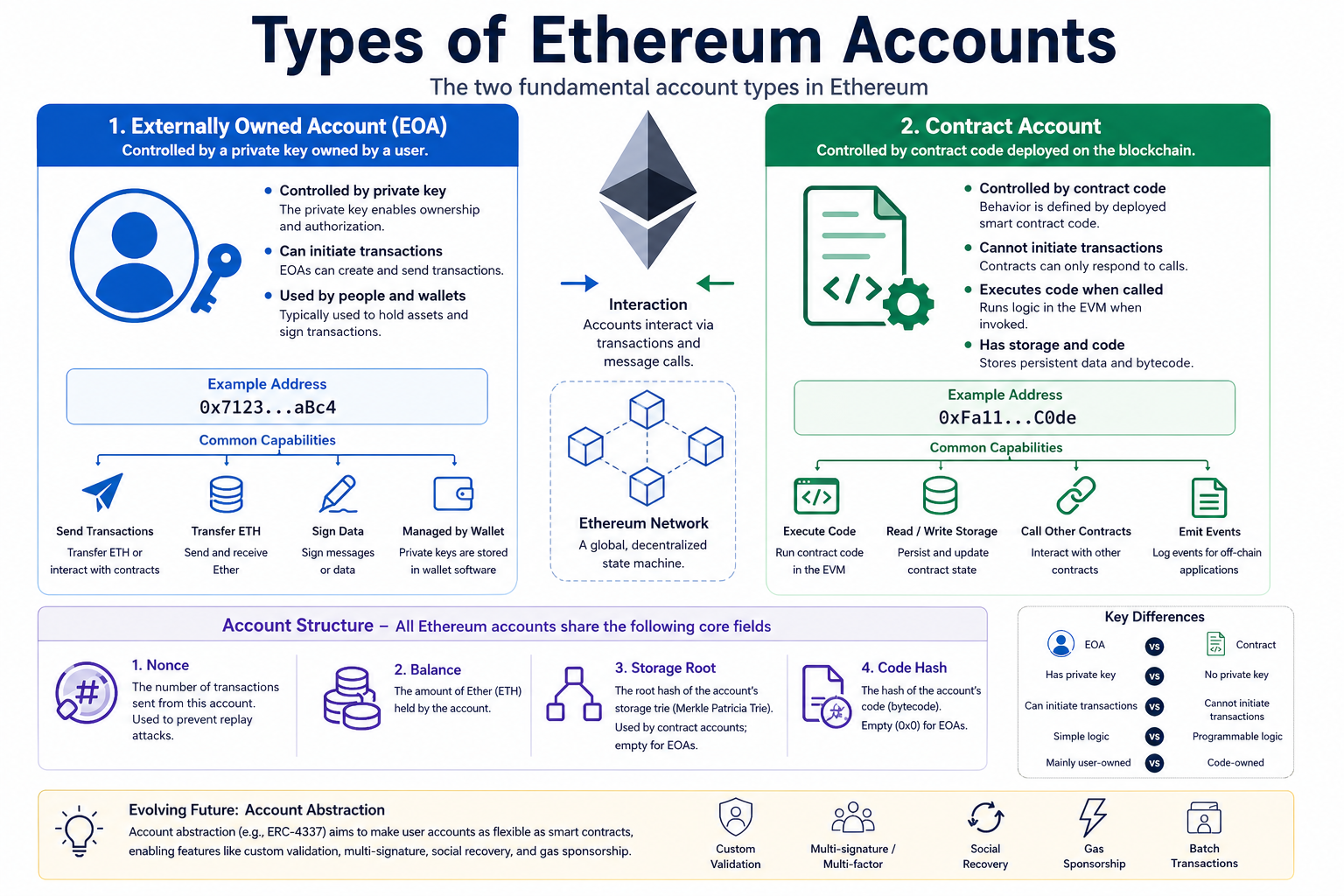
Ethereum defines two primary types of accounts: Externally Owned Accounts (EOAs) and Contract Accounts. These account types differ fundamentally in terms of control, functionality, and lifecycle.
Externally Owned Accounts are controlled by private keys and typically represent user wallets. Their primary role is to initiate transactions and sign data. All transactions must originate from EOAs, as only they possess cryptographic signing capability.
Contract Accounts, on the other hand, are controlled by smart contract code deployed on the blockchain. They do not have private keys and cannot initiate transactions independently. Instead, they execute code in response to incoming calls.
Externally Owned Accounts: The User Interaction Layer
Externally Owned Accounts serve as the main interface between users and the Ethereum network. Each EOA is derived from a public-private key pair, with the address typically being a hash of the public key. Users control their assets through private keys and authorize actions via cryptographic signatures.
In practice, EOAs are managed through wallet software such as MetaMask, which handles key storage, transaction construction, and signing processes.
A key characteristic of EOAs is their dependence on gas fees. Every transaction initiated by an EOA requires payment for computational resources, ensuring efficient use of the network.
Contract Accounts: Programmable Execution Units
Contract Accounts represent one of Ethereum’s most significant innovations. They consist of smart contract code stored on the blockchain and include both executable code and persistent storage.
Smart contracts are typically written in Solidity and deployed to the network, receiving a unique address. Users and other contracts can interact with them by invoking functions, enabling automated processes such as decentralized exchanges, lending protocols, and token issuance.
Execution is handled by the Ethereum Virtual Machine (EVM), and the outcome directly affects the blockchain state. This mechanism underpins Ethereum’s role as a global computing platform.
Account Structure: Four Core Fields
Both EOAs and Contract Accounts share a unified data structure within Ethereum. Each account contains four essential fields:
- nonce: the number of transactions sent, preventing replay attacks
- balance: the amount of Ether held by the account
- storageRoot: the root of the account’s storage trie (relevant for contract accounts)
- codeHash: the hash of the account’s code (empty for EOAs)
This consistent structure ensures reliable state management and cryptographic verification.
Behavioral Differences: Active vs Passive Execution
EOAs and Contract Accounts exhibit distinct behavioral patterns. EOAs can actively initiate transactions due to their private key control, whereas Contract Accounts operate passively, executing code only when invoked.
Additionally, EOAs primarily handle asset management and transaction initiation, while Contract Accounts enable complex logic, state transitions, and inter-contract communication. This division balances security and flexibility within the system.
Account Interaction: Transactions and Message Calls
Interactions between accounts in Ethereum occur through transactions and message calls.
Transactions are initiated by EOAs and may result in Ether transfers or contract execution. Message calls typically occur between contracts and do not create standalone transactions, although they still consume gas.
This dual interaction model enables complex execution flows and multi-contract coordination.