In crypto derivatives markets, perpetual futures do not have a traditional expiry date. To keep perpetual contract prices close to the underlying spot or index price, exchanges use a mechanism known as the funding rate. In simple terms, funding fees are periodic payments exchanged between long and short position holders. They are not usually a trading fee paid directly to the exchange. When the funding rate is positive, longs typically pay shorts. When it is negative, shorts typically pay longs.
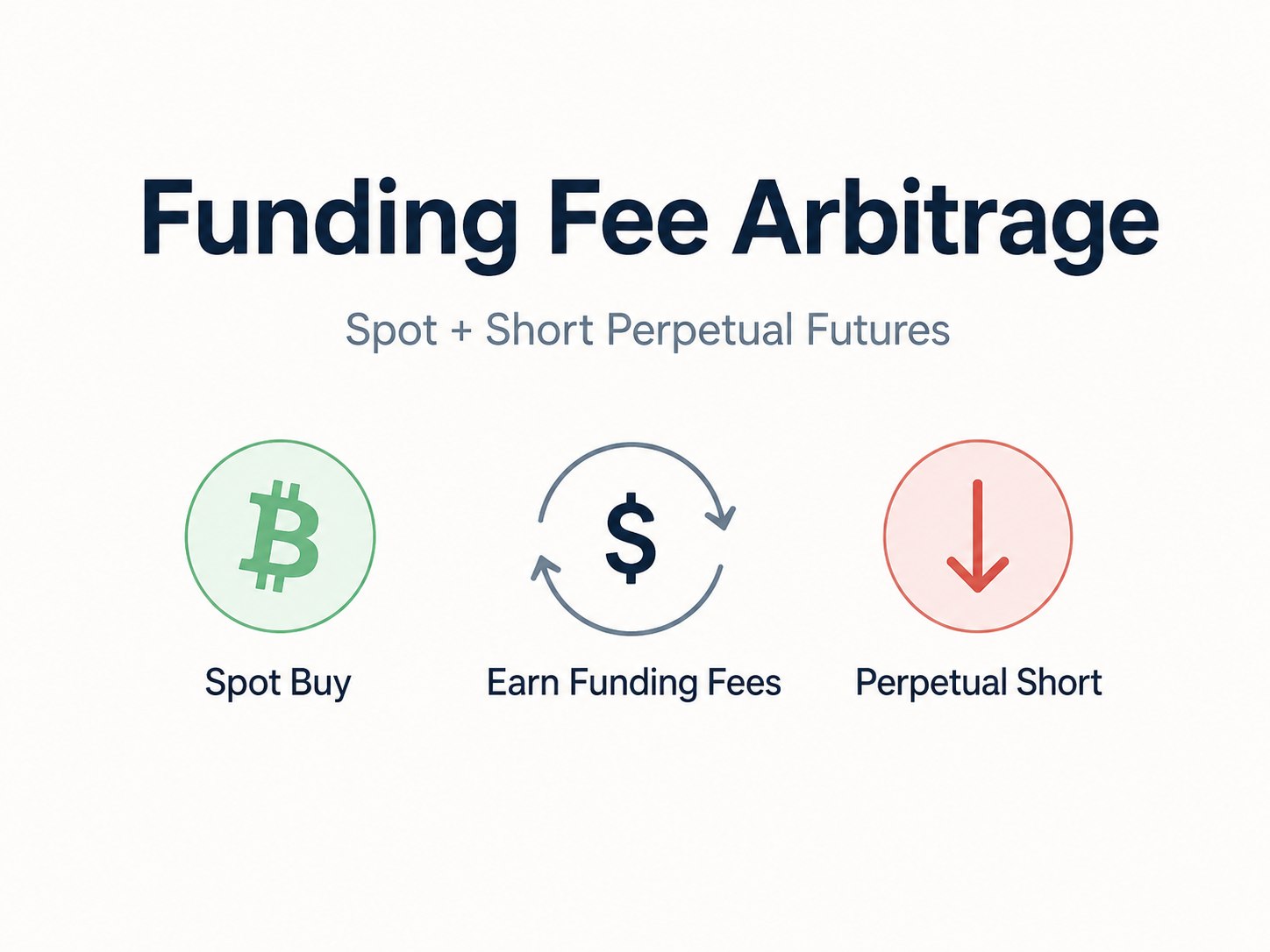
Funding fee arbitrage aims to capture these periodic payments by building a hedged position. For example, when the funding rate of a perpetual contract remains positive, a trader may buy the spot asset and short an equivalent notional amount of the perpetual contract. The spot long and perpetual short offset each other directionally, while the short perpetual position may receive funding payments.
However, funding fee arbitrage is not risk-free. It is better understood as a market-neutral trading strategy . The source of return is identifiable, but the risks are embedded in execution, changing funding rates, liquidity, leverage, exchange rules, and extreme market conditions.
1. Where Do Funding Fees Come From?
Unlike traditional futures, perpetual contracts do not expire. Without an additional balancing mechanism, their prices could drift away from the underlying spot market. Funding rates create an incentive for traders to rebalance positioning by requiring one side of the market to pay the other.
In general, when market sentiment is bullish and the perpetual price trades above the spot price, the funding rate may become positive, meaning longs pay shorts. When market sentiment is bearish and the perpetual price trades below the spot price, the funding rate may become negative, meaning shorts pay longs.
Funding calculations, settlement intervals, and parameters vary across exchanges. Some platforms calculate funding rates based on a premium index, interest-rate component, market depth, and the degree to which the contract price deviates from the index price. Before applying any funding arbitrage strategy, traders should understand the specific exchange’s funding rules, settlement cycle, risk limits, and margin system.
2. The Basic Structure of Funding Fee Arbitrage
The most common structure is a spot plus perpetual hedge .
Suppose the BTC perpetual funding rate is positive. A trader may buy 1 BTC in the spot market and short an equivalent notional amount of BTC perpetual futures. This keeps the overall position relatively direction-neutral while the trader waits for funding settlement and potentially receives funding from the short perpetual position.
If BTC rises, the spot position gains while the short perpetual loses. If BTC falls, the spot position loses while the short perpetual gains. In theory, the directional profit and loss on both sides should roughly offset, leaving funding income as the main return driver.
When the funding rate is negative, the structure may be reversed: long the perpetual contract and hedge with a short spot position, borrowed asset, or another instrument. In practice, negative funding arbitrage can be more complex because it may involve borrowing costs, short availability, liquidity constraints, and platform-specific limitations.
3. How Is the Return Calculated?
The key question is not “How high is the funding rate?” but rather: Is the net return positive after all costs?
A simplified formula is:
Net return = funding received − trading fees − slippage − borrowing or financing costs − transfer costs − potential losses
For example, if a perpetual contract has a funding rate of 0.01% per settlement interval and the notional position size is 100,000 USDT, the theoretical funding received for one interval would be:
100,000 × 0.01% = 10 USDT
But that is only gross income. The actual result must account for entry and exit fees, bid-ask spread, slippage, spot trading costs, transfer costs, financing costs, and margin requirements. If leverage is used, liquidation risk must also be considered.
The real challenge of funding fee arbitrage is not understanding the formula. It is determining whether the funding rate is sustainable, whether the hedge is accurate, whether costs are controlled, and whether the account has enough margin to survive volatility.
4. Major Risks of Funding Fee Arbitrage
1. Funding Rates Can Change Quickly
Funding rates are not fixed income. They change with market sentiment, contract premiums, interest-rate components, and exchange-specific mechanisms. A high funding rate today may fall sharply before the next settlement, or even turn negative.
Therefore, traders should not only look at the currently displayed funding rate. They should also review historical funding patterns, market sentiment, trading volume, contract premium, and the volatility of the asset.
2. The Hedge May Not Be Perfect
Spot and perpetual prices do not always move in perfect sync. Even with a hedged structure, traders may face basis expansion, execution slippage, insufficient order book depth, or price discrepancies across venues.
During sharp market moves, a theoretically market-neutral position may still experience temporary losses. If the trader uses high leverage, such temporary losses can lead to margin pressure or even liquidation.
3. Leverage Can Create Liquidation Risk
Many funding arbitrage strategies involve perpetual contracts, which often allow leveraged trading. Leverage improves capital efficiency but increases margin pressure.
For funding fee arbitrage, one of the biggest risks is not necessarily being wrong about market direction. The bigger danger is that, during extreme volatility, the hedged position has not yet generated the expected funding income, but the perpetual side is liquidated due to insufficient margin. Once one leg of the hedge is forcibly closed, the originally neutral structure becomes a directional exposure.
4. Fees and Slippage Can Eliminate Profit
Funding arbitrage often has a thin return per settlement period. Maker fees, taker fees, bid-ask spreads, transfer fees, gas costs, borrowing fees, and slippage can quickly turn a seemingly profitable opportunity into a negative-return trade.
This is especially important for smaller-cap coins, low-liquidity markets, or periods of severe volatility. If traders only calculate funding income but ignore real execution costs, the final result may be very different from expectation.
5. Exchange and Rule Risk Matter
Funding-rate formulas, settlement times, maximum funding caps, margin rules, risk limits, and liquidation mechanisms vary by exchange. Traders should not rely only on the displayed “estimated funding rate”; they need to understand the full contract specification.
In addition, platform outages, matching-engine delays, withdrawal suspensions, risk-control adjustments, and contract-parameter changes may all affect strategy execution and exit.
6. Crypto Assets Are Highly Volatile
Funding fee arbitrage attempts to reduce directional risk, but it cannot eliminate market risk. Crypto assets are highly volatile, and extreme conditions may lead to liquidity gaps, sudden price spikes, stablecoin depegging, or wider price differences across exchanges.
Therefore, funding arbitrage should not be treated as a fixed-income product, nor should it be presented as a guaranteed-profit strategy. Its return comes from market structure, but its risk also comes from market structure.
5. Who Should Study Funding Fee Arbitrage?
Funding fee arbitrage is more suitable for traders with trading experience and risk-management capability.
Participants need to understand spot markets, perpetual futures, margin, and liquidation mechanics. They should be able to calculate total costs rather than focus only on headline funding rates. They also need discipline around position sizing and leverage, the ability to tolerate funding-rate reversals, wider spreads, and short-term drawdowns, and the awareness to diversify platform risk and prepare exit plans.
For beginners, funding fee arbitrage should not be viewed as passive income. A better description is this: it is a strategy that attempts to monetize the structure of perpetual futures markets while managing a complex set of risks.
6. Pre-Trade Checklist
Before entering a funding fee arbitrage trade, traders should ask:
Is the current funding rate a temporary spike or a persistent opportunity?
Has the expected return been adjusted for fees, slippage, and financing costs?
Are the spot and perpetual positions matched by notional value?
Is leverage being used conservatively?
What happens if the funding rate reverses?
Is there enough margin to withstand volatility?
What is the backup plan if withdrawals are delayed, liquidity disappears, or exchange rules change?
This checklist does not remove risk, but it helps prevent a common mistake: confusing funding income with guaranteed income.